Monday, July 20, 2009

Pizza and dessert

A while back some friends that were visiting France for a conference came for dinner. We made a quick pizza with ham, tomato sauce (oil, onion, garlic, tomato, pinch of sugar, salt, pepper) fresh tomatoes, mushrooms and two kinds of cheese.

For the dough mix flour, yeast, salt, water, and an egg. Normally you don't need an egg, but we were hungry and didn't want to wait long, so I used an egg for the extra protein to make the dough more elastic faster, instead of more kneading and more waiting for the yeast.

While waiting for the pizza, I also made a dessert. We also had some chocolate ice-cream with it, a nice contrast to the hot fondant.

Is there such a thing as too much chocolate?

Chocolate soufflé moccha cake

You might want to skip this one if you're on a diet. This is a cake I improvised during a weekend. It came out alright, so here it goes.

First I made a chocolate soufflé:
  • 9 eggs, separated
  • 1 cup of sugar
  • 1 pound dark chocolate
  • 1/2 cup butter
Butter and flour a tall round baking pot. Melt the chocolate with the butter in a bain-marie (or in the microwave, carefully) and set aside. Beat the yolks with most of the sugar (keep a spoon for the meringue) until they turn ivory. Beat the whites into a meringue with 1 spoon of sugar. Fold the chocolate in the yolk mixture, and then gently fold the meringue in, careful to keep most of the air. Move to the buttered baking dish, and cook in a medium hot oven until it's slightly jiggly in the center. Let it cool, unmold on a plate, and refrigerate overnight.

The next morning, I made some pastry cream:
  • 1 cup of milk
  • 1 cup of cream
  • vanilla extract (or bean, if you have)
  • 4 spoons of flour
  • 2 egg yolks
  • half a cup of sugar
  • half a cup strong coffee
Set a pot with a cup of milk and a cup of cream over low flame. Add some vanilla, half the sugar and strong coffee. At the same time, beat one egg yolk with the rest of the sugar until ivory. Sift four tablespoons of flour in, and mix. Keep stirring and add the hot (but not boiling) milk and cream. Move to the pot over low flame and stir until it thickens. Set aside to cool, and mix often to avoid a crust. I didn't, so I had to peel the crust off when it was cold and eat it, sadly.

For garnish, I made a ganache and some whipped cream:
  • 250g heavy cream
  • 250g dark chocolate
  • 1 spoon of confectioner's sugar
Whip half the cream with the confectioner's sugar until it formed soft peaks for the chantilly cream. Warm the rest up and mix with the chocolate, stirring until all the chocolate melts and the mix becomes smooth.

Then, bring it all together. Using a long serrated knife, slice the tall soufflé into three layers. Alternatively, use a normal knife to make a shallow cut all around at one third of the height, wrap the cake using a piece of thread so that it's in the cut, and pull the two ends of the string to make a very even cut. Repeat for the other layer.

Place the widest layer on a wide dish and spoon half the mocha cream on top. Put the next cake layer over, and top with the rest of the mocha. Finish with the third layer of cake, then garnish with the ganache. Pour a spoon of ganache on the top of the cake, and push it around with a spatula to cover it. Keep pouring one spoon of ganache at a time on top of the cake, and push it around with a spatula to drip evenly around the cake. Wipe any excess ganache from the bottom of the plate, make sure the cake is coated on all sides, and refrigerate for the ganache to set. After a few hours, garnish the cake on top with the whipped cream.

Overall it was nice and very chocolaty. The soufflé was nice instead of an actual cake, even though it doesn't have flour, because it was moist and hadn't deflated. The coffee flavor combines well with the chocolate and stops it from being overwhelming. I didn't use too much sugar and the chocolate was 75% cocoa, so it wasn't very sweet either, just right. If I was to change anything, next time I might try to get a little cognac somewhere in there. It is excellent with a bitter espresso.

Ratatouille

Ratatouille is a fast and tasty (and vegetarian) side dish.

Ingredients
  • 2 onions
  • 2 cloves of garlic
  • a bell pepper
  • 1 large eggplant (or 2 small)
  • 1 zucchini
  • 2 tomatoes
  • basil
  • parsley
  • dried thyme
  • olive oil
  • 1 spoon of tomato purée
Start by sautéing the garlic in a bit of olive oil, over a low heat, for about 30 seconds to 1 minute.

Add the onion and sauté until transparent. Then add the eggplant in cubes or thin slices, a pinch of salt, and toss it a bit with a wooden spoon to oil all around. After a couple of minutes add the zucchini, sliced, and the bell pepper, chopped, and another pinch of salt. Stir for 5 minutes and add the herbs and chopped tomatoes. If the vegetables haven't leaked enough juice to have a thick sauce by now, add a bit of tomato paste and if necessary, a few spoons of water, a final pinch of salt, and pepper. Cook for another 10 minutes.

You can eat it like that, hot or cold. I wanted to use it to escort some fish, so I moved it to serving-sized cocottes, topped with breadcrumbs and a drop of olive oil, and put them in the oven for a few minutes to get a nice gratinée crust. Alternatively, you can eat it the next day with an egg on top.

My favorite is to spoon it with some hot just-out-of-the-oven bread. (Yes, the small breadrolls leaked some cheese again, but I'll keep practicing).

Spanakopita

This is yet another post about dough. This one is a pastry dough called "phyllo", the Greek word for leaf. That name is very general, as it applies to any kind of dough that is rolled into a thin leaf. This specific one is a recipe I got from grandma, and is really good for making pitas. It's very similar to standard puff pastry (or pâte feuilletée) except there's no folding of the dough, resulting in a puff pastry with fewer, thicker layers.

The ingredients are the simplest ever: flour, water, salt. Like the original puff pastry, this one is unleavened. Start with two cups of flour and a pinch of salt, and keep adding water and kneading until you get a soft dough that doesn't stick to your hands. If you add too much water add more flour. Knead for about 10 minutes, then refridgerate for half an hour at least.

Take it out of the fridge, and roll it with your hands into a long worm, about 2 inches in diameter. Then cut that in half, again and again, until you get 8 to 16 pieces, the size of mandarin oranges. A kilogram of flour gives 16 small pieces.
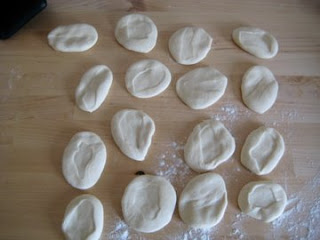
Roll each piece around in your hands to make it a bit more spherical, and press it down on the table to flatten it with your palm. Using a rolling pin, roll each into a circle of about 5 inches in diameter.

Take some softened butter or margerine with your fingers, and rub it softly on each circle before you stack the next one on top. I made 4 stacks of 4 pieces each, with butter inbetween. Don't butter the bottom and top layers! Then refridgerate for 20 minutes. At this point, if you have made too much dough, you can wrap each stack in tinfoil or plastic wrap and freeze them. Take them out of the freezer to thaw the day before you need it, it's as good as fresh.

When ready to use, sprinkle flour on the table, and gently roll each stack into a thin wide sheet. It doesn't have to be extremely thin, 1mm thick is fine. Yielding to popular demand, I made mine into a spanakopita. This might seem like a sacrilege to many fellow Greeks, but I don't like feta, so my pita was cheeseless.

For the stuffing, chop and blanch the spinach for 3-4 minutes to soften it a bit, drain and mix with chopped dill, scallion and parsley. Add one egg (or two if you have a lot of stuffing), salt and pepper, a couple of spoons of olive oil, and mix. You can add feta to taste, too.

Then roll one of the sheets of dough around the rolling pin and transfer it on an oven pan. Stretch it to cover the whole pan, with some dough over the edges. Sprinkle some olive oil and add another sheet if you rolled them too thin. Spread the stuffing all over, and then transfer another sheet of dough over it, also stretching it to go a bit over the edges.

Drizzle some olive oil on top, and add another layer of dough, if it's too thin. My first top-layer wasn't big enough so I used a second, wider layer on top of it. Make sure you oil or butter the dough around the edges in between the sheets. This is not the time to cut down on fats, so use lots of oil on the edges.

Then roll the dough that is hanging over the edges, to seal it around. This is my favorite part of the pita, the rolled and crunchy phyllo at the corner piece. Again, make sure it's oiled there. Finally, sprinkle some extra oil on top, mark pieces with a knife, stab it a few times to let the steam out during cooking, and bake in low to medium heat for about an hour, to an hour and a half.

Unfortunately my gas oven only heats things from underneath, so I didn't get the golden-brown color that I should...

... luckily, people still liked it.

Saturday, July 18, 2009

Œuf cocottes

This post has been in the draft list for a while now. So, here it is, a quick snack.

In French, cocotte is usually what in English is called a Dutch oven. It can also mean a hen, or a... woman of questionable virtue and high maintenance.

However, cocottes come in much smaller sizes too, and you can use them to cook single servings. An œuf cocotte is a fancy name for what is really just an egg in a ramequin. It's a quick snack, and easy to make too.

I made a couple of œuf cocottes a while back, with some bits of ham, cheese, tomato, basil and, of course, an egg on top. I had some stuffing left and I put some cheese over it, for a cocotte gratinée. This is also easy to do with leftover foods, and especially good with yesterday's ratatouille. A small trick: before breaking the egg wipe it and push it on the middle of the stuffing to make a small crater. Then break it close to the cocotte careful not to break the yolk, so that it rests in the middle. Cook in the oven for a few minutes depending on how runny you want the egg.

Mmm, quick and tasty.

Tuesday, June 23, 2009

Dough and cheese

I like making bread. Kneading dough is relaxing, and also nice to punch, if you want to vent some anger. If you're not breaking a sweat, you're not doing it right. Sadly, I haven't had much time to bake recently. Even worse, I also neglected to feed my starter regularly. It's still alive (yeast doesn't die that easily) but it got a bit too sour and weak, taking too long to rise. So, I decided to kill it and start over. How do you kill a starter? Well, you bake it!

So, one day I woke up real early, and made a bread dough with all of the starter (about 3 cups), salt, and whole wheat flour. I kept the starter a bit watery, so it took around 1.5kg of flour to get the right dough consistency. That was a large batch of dough (for my standards), so it was lots of fun to knead. I left it in a bowl in the sun, covered by plastic wrap, and went to work. Sun heat did wonders, so much that I contemplated saving some of the starter, because it had risen nicely. I decided against it in the end. I think the sour starter (or maybe it was the sunlight) produced more alcohol than it used to, because the dough was softer than usual.

I deflated the dough pressing it down, and kneaded it with a bit more flour to get it back to a nice consistency. I made half the dough into a loaf, and decided to experiment a bit with the rest.

I had a camembert cheese in the fridge, and decided to make a bread with it. I thought that a whole cheese was too much for a single loaf, so I sliced it in half, rolled a bit of dough, and wrapped the two halves with dough. I also made some small rolls and a croissant with some brie cheese in the center.

I still had some dough left, so I made yet another kind of cheese pita. For this one, roll the dough into a thin long stripe, around 2 inches wide. Then grate whatever cheese you have, I used what was in the fridge, parmesan, a mild goat cheese, and some brie. I guess this will be a good one for feta, but I don't like feta. Spread the cheeses on the dough stripe, in the center, and fold it lengthwise over the cheese. Then bring the roll all around, rolling it like a snake. Ideally, you can brush it with some egg wash for color and a shiny finish, but I didn't. Let everything rise for an hour, and bake in a hot oven. Unfortunately, my gas oven has a strong flame underneath, but the heat is not evenly dispersed, and bread cooks before the top crust gets brown enough. It's still tasty though.

The small pieces were done first. Unfortunately, the cheese melted very fast, and the dough was still rising, pushing the melted cheese out. There was some left inside and they tasted good. Next time I'll use a harder cheese though, camembert and brie melt very fast.

The same thing happened with the half-camembert bread. The inside was nice and melted, but some of it escaped and got burnt.

Yet again, the pita also leaked some of the brie. It was still tasty!

Saturday, June 20, 2009

Dijon mustards with tapas

It's been a while since I last posted. Work is piling up, and there isn't much time to cook, sadly. I won't be in France for long, and there's a mountain of things to finish, and many places to go, before I leave.

Despoina was here a couple of weeks ago, and we took the train to Dijon, the capital of Burgundy, or Bourgogne, as they say here. It was a nice trip, albeit a bit too long for a single day, almost four hours each way.

Dijon is a nice city, with an impressive town center, full of old, stone buildings. This is a massive cathedral that looks very medieval, especially when you stand right next to it.

The town center was all pedestrian, stone-paved narrow streets, with tightly packed houses all around. The architecture looked a bit strange, the ground floor is all stone-built, and there are stone-built pillars and chimneys above, but the rest of the building (usually two extra floors) was wood and plaster. Some even had mini-gargoyles carved on the wood of the upper floors. I haven't seen houses like in the Rhône-Alpes region, but it was everywhere in Burgundy.

Here's a funny detail that we liked. The stone-paved streets were marked with triangular arrows, depicting an owl (a local good-luck symbol). The arrows mark a "scenic path" that tourists can follow to visit all the important sights. Cool!

After walking around the old town center for a few hours, we sat at an old café on a small square, for a well-deserved rest. They served an amazing capuccino ice-cream with chocolate.

Of course, when talking about Dijon the word "mustard" immediatly comes to mind. There were small tourist shops peppered all over the center, selling small jars of mustard. We bought ten kinds of mustard.

We were famished by the time we got home, after four hours in the train. So, we made some quick snacks. We made some salad with tomato, basil, mozzarela and mushroom, served on lettuce leaves. Half of the ingredients served stuffed, and the other half finely chopped. We also made two small soufflés. Separate two eggs, and beat the whites into meringue. Beat the yolks with a touch of milk, and grate cheese in them. Then fold with the meringue and bake. I used the new serving-sized petites cocottes that Despoina bought, they're great for a personal soufflé. We grilled a couple of saucisses for each to eat the mustards with, and made a few bruschettas with sliced baguette, olive oil, mushroom, basil and mozzarela.

I remembered to take a picture only after finishing my soufflé... but you can see the mustard jars! I liked one with herbes de Provence and a spicy one with horseradish.